
How to Outsource Your Podcast Editing (Without Losing Your Brand Voice)
-banner.png)
You are working too hard on your podcast.
Most hosts try to do every task alone.
If you have done this, you know the burnout is real.
You want to outsource podcast editing.
But you are scared an editor will ruin your style.
You worry they will cut your best jokes or your favorite stories.
This does not scale.
You spend five hours cutting out "umms" for a short show.
You miss time with your family or your actual job.
If you only make one show a month, keep doing it yourself.
For everyone else, you need a system.
You can keep your voice and get your time back.
The "Handover Hurdle": Why Most Podcasters Are Afraid to Outsource
Giving your audio to a stranger feels wrong.
Your podcast is your baby.
You know your brand voice better than anyone.
You think outsourcing means losing quality control.
You fear a new editor will ruin your timing.
For example, they might cut the funny pause before your punchline.
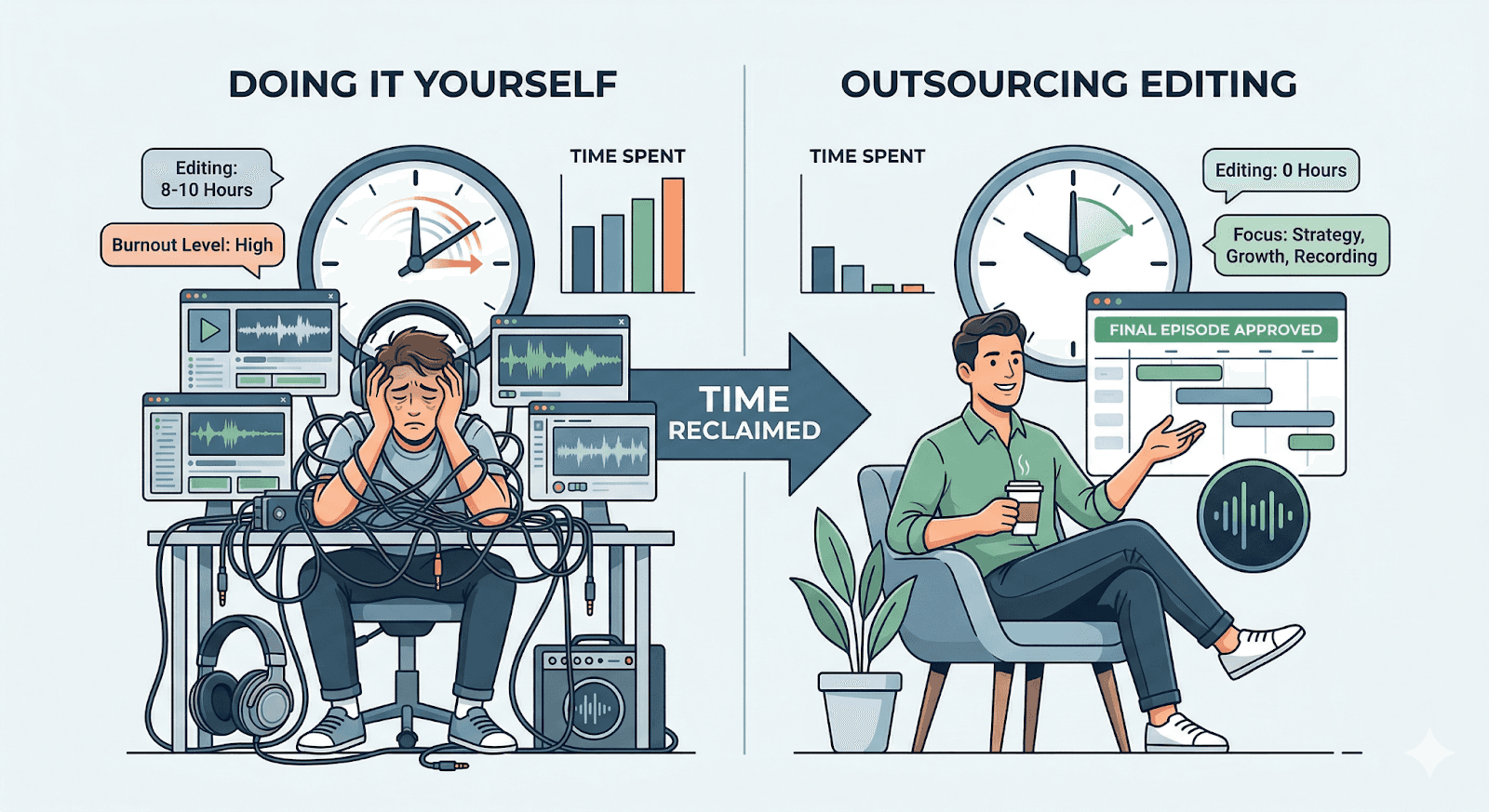
The DIY trap will kill your show.
If you edit audio at 2 AM, you know this trap well.
You spend ten hours editing just one hour of tape.
Source: The Podcast Host
Year: 2023
Finding: Editing takes the average podcaster 3 to 4 times longer than recording the actual audio.
Context: This massive time drain proves why the DIY approach quickly leads to burnout.
If you just want basic cuts, use a free AI tool.
But a real podcast post production workflow protects your voice.
It does not erase your style.
The best shows are never solo acts.
They rely on strong systems.
They outsource podcast editing to win back their time.
How to Find a Podcast Editor Who "Speaks" Your Language
Cheap editors will ruin your show.
Do not just look at their hourly rate.
You must check their portfolio for the right pacing.
There is a huge gap between an audio tech and a story editor.
A tech just removes background hiss.
A story editor knows when a guest needs a dramatic pause.
If their past work is just dry lectures, skip them.
They will fail at cutting a fast comedy show.
This mismatch breaks under pressure.
When you learn how to find a podcast editor, ask hard questions.
Ask them: "How do you handle my specific brand guidelines?"
Always pay for a trial episode first.
This trial tests your feedback loop before you sign a contract.
If you have ever fought a freelancer over bad edits, you get this.
Find someone who knows your exact niche.
A strict B2B sales show needs different cuts than a true crime story.
If you just post raw audio from a live stream, skip this step.
The Seamless Handover: A 4-Step Podcast Post Production Workflow
Handing over files by email is a massive mistake.
If you have tried attaching giant files to a message, you know the pain.
A messy folder system guarantees a bad final cut.
If you only upload unedited live streams, you do not need this.
But serious shows need a strict podcast post production workflow.
Here is how to do it right.
Step 1: Asset Management
Put all raw audio in Google Drive or Dropbox.
Name your files clearly.
For example, name them "Episode 45 - Guest Name" so nothing gets lost.
Step 2: The Style Guide
Give your editor a brand bible.
Tell them exactly where the intro music fades out.
List your preferred transitions and sound effects here.
Step 3: The Edit & Review
Set up a fast feedback loop.
Do not just say "fix the middle."
Tell them to cut the loud dog bark at the five-minute mark.
Step 4: Final Delivery
You should get ready-to-publish mastered audio and show notes.
A great team also sends clips for content repurposing.
This turns one show into ten short social media videos.
This works because of SOPs.
Standard Operating Procedures remove all guesswork from the editor.
Without them, the whole process breaks under pressure.
Protecting Your Pacing and Tone (The "Human" Element)
A bad editor cuts out the soul of your show.
They just chop out dead air to save time.
But a pro looks at your narrative structure.
If you have heard a robot-sounding edit, you know this pain well.
A good editor leaves the long pause after a sad story because it matters.
You must give time-stamped feedback early on.
Tell them exactly what to change.
For example, say "make the gap at 12:05 shorter."
Guessing games ruin good audio.
Soon, they will learn your pacing.
They become like a member of your band.
If you just read a script straight through, this does not matter.
Systems Over Stress: Why You Need More Than Just an "Audio Guy"
Hiring a random audio guy is a huge mistake.
If a freelancer ghosts you before launch day, you know this stress.
You do not just need a person.
You need a system.
A solo freelancer is a single point of failure.
If they get sick, your show stops.
This breaks under pressure.
A professional podcast editing service provides true reliability.
You outsource podcast editing to a whole team.
Think of this like hiring a head chef.
You give them the raw audio as ingredients.
They use your brand guidelines to cook the meal.
A strong team also gives you integrated services.
For example, they write your show notes and transcripts.
If you just run a hobby show for fun, hire the cheap guy.
Serious shows need a system that always works.
FAQ
Is it safe to share my raw podcast files via cloud storage?
Yes, cloud platforms are industry standards for secure asset management. Just ensure you set the correct folder-level sharing permissions for your editor.
How many revisions should I expect when I first outsource?
Expect 1-2 rounds of minor revisions for the first few episodes. A good editor uses this time to learn your specific brand voice and pacing.
Do I still need to write my own show notes if I hire an editor?
Not necessarily. Many comprehensive production agencies include show notes and content repurposing directly in their service packages.
How long does it take an editor to learn my style?
With clear SOPs and a structured feedback loop, a professional agency should seamlessly match your brand voice within 2 to 4 episodes.