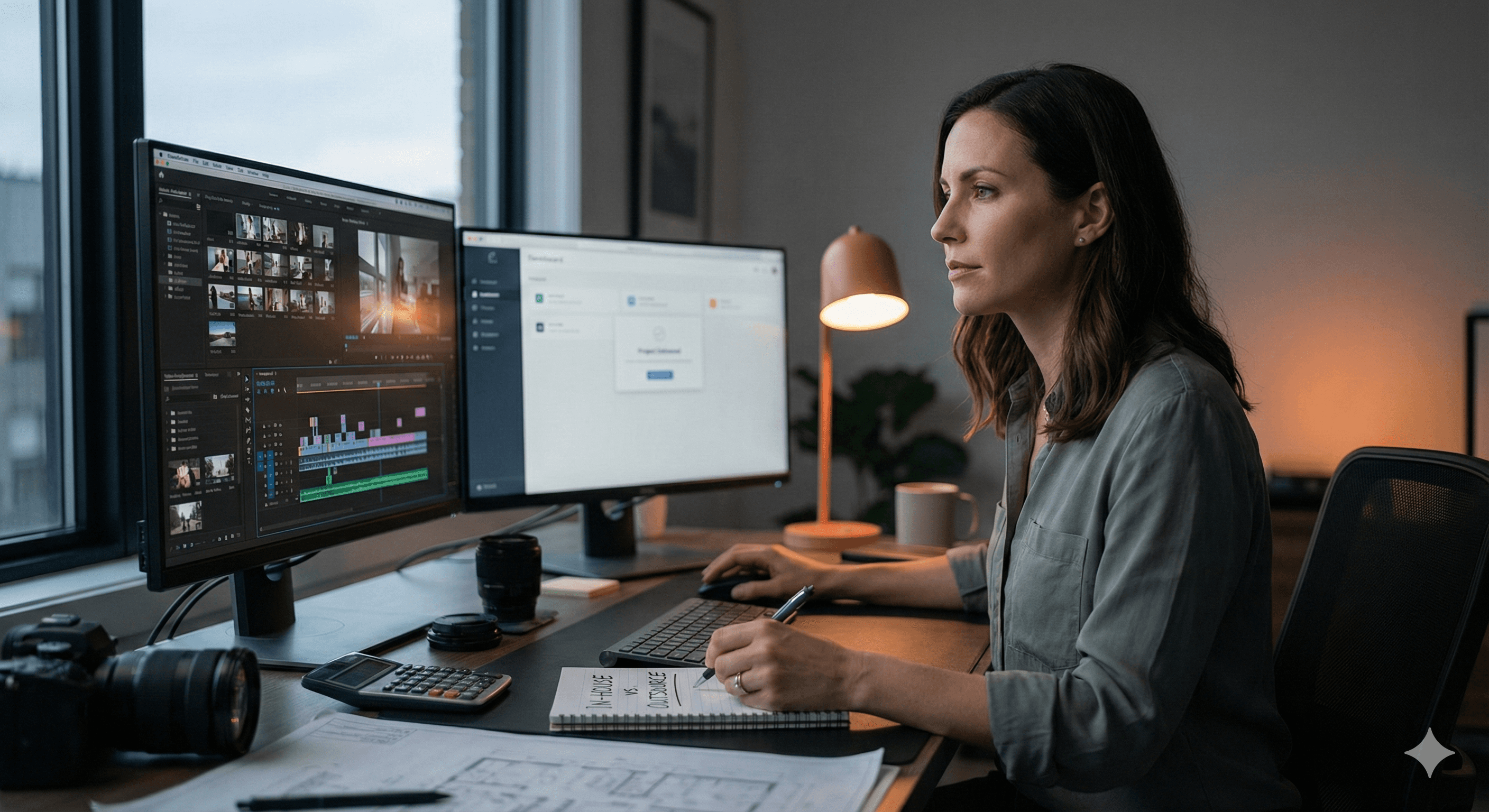
It feels safer to hire someone you can see. You want control. You want to walk over to a desk and ask for a quick change. We get it. That feeling of control is comforting.
But comfort is expensive. When you crunch the numbers to outsource real estate video editing versus hiring in-house, the "safe" choice often reveals itself as a massive financial leak.
You might look at an annual salary and think that’s the final price. It never is.
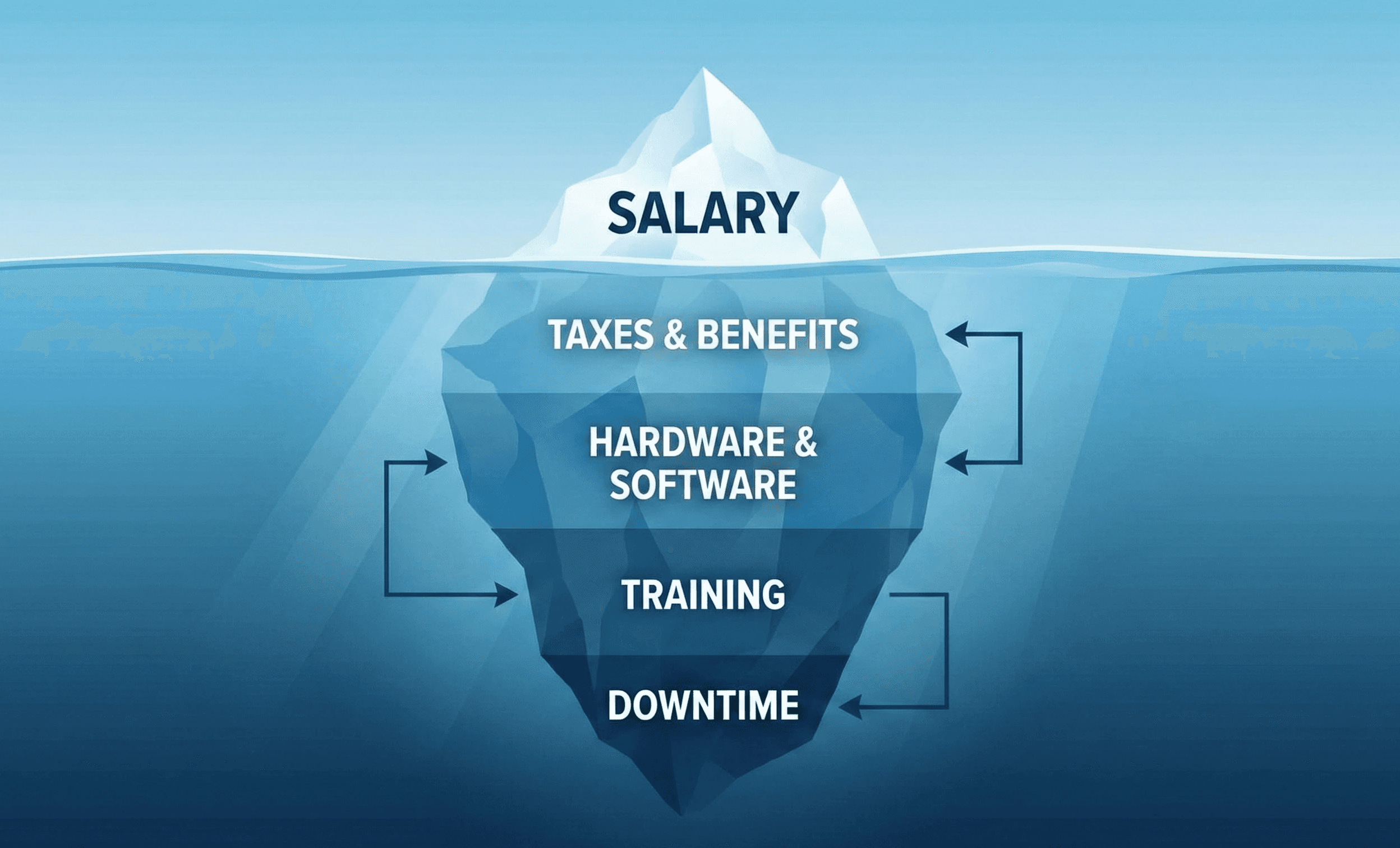
The Real Cost of In-House Editing (It's Not Just Salary)
Let’s look at the math. When you think about hiring real estate video editor talent, you usually look at the hourly rate. That is the wrong number to watch.
The "sticker price" is just the start.
First, you have Employee overhead. This is the silent budget killer. You have to pay Payroll taxes. You have to cover sick leave. If you offer benefits, add that to the pile. A $50,000 salary often costs the business closer to $65,000.
Then comes the gear. You can’t put a professional editor on a basic laptop. They need a powerful Workstation to handle 4K footage without crashing. You also need to buy the software. An Adobe Creative Cloud License is a monthly fee that never goes away.
But the biggest cost is downtime.
Real estate has slow weeks. It rains. Listings drop. If you have an in-house employee, you pay them to sit there. You are paying for their time, not their output.
If you run a massive operation with constant daily volume, maybe this math works out. But for a growing agency? Paying someone to wait for work destroys your profit.
The Opportunity Cost: Is Editing the Best Use of Your Time?
Editing your own videos is like a pilot serving drinks in the cabin. You can do it, but who is flying the plane?
We see this all the time. You finish a shoot, come home, and sit at the computer until midnight. You think you are saving money. You are actually losing it.
This is called opportunity cost. It asks a simple question: "What could you have earned in those 4 hours you spent editing?"
If you are a photographer or agency owner, your time is worth money. Let’s say your hourly rate for shooting is $150. If you spend three hours editing a video to "save" $50, you just lost $400 in potential income.
You are stepping over dollars to pick up pennies.
Time spent editing is time not spent shooting or selling. When you are stuck in Premiere Pro, you aren't calling new clients. You aren't building relationships. You aren't growing.
Delegation is not an expense. It is a profit multiplier. It buys your time back so you can focus on high-value tasks. This is how you protect your Profit margin. You cannot grow a business if you are doing the lowest-value work yourself.
Real estate agents/photographers spend up to X% of their week on non-income generating tasks like editing.
If you want Operational efficiency, you have to let go. You can be the editor, or you can be the CEO. You cannot be both.
How Outsourcing Changes the Math (The ROI Breakdown)
In-house staff is a "Fixed Cost." You pay the same amount every month, regardless of your revenue.
You pay that salary on slow weeks. You pay it when listings dry up in the winter. You pay it when it rains and you can't shoot. That money leaves your account whether you are profitable or not.
Outsourcing is a "Variable Cost". You only pay when you actually have work.
If you have a slow month, your editing bill drops. If you have a busy month, you scale up instantly. You are never paying for someone to sit around and wait. This protects your cash flow in a way a salary never can.
Then there is the panic of the "sick day."
You know the feeling. You have a deadline, and your editor texts you that they have the flu. Your entire business stops.
A remote video editing team fixes this. They don't rely on one person. If an editor is sick, someone else takes the files. The machine always runs. This consistency allows you to promise deadlines to clients without sweating.
It also speeds you up. We call this time-to-market.
A local employee works 9-to-5. They start editing the morning after the shoot. Global teams often work while you sleep. You upload the footage at night. You wake up to a completed link in your inbox.
One of the key benefits of outsourcing video editing is this speed. You deliver faster than your competition because your business runs 24 hours a day.
In-House vs. Outsourced: The Comparison Table
You can stare at spreadsheets all day. Sometimes you just need to see the difference side-by-side.
In-house vs outsourced video editing isn't just a budget question. It is a speed question. If you have ever missed a listing deadline because your editor was overwhelmed, you know this pain.
Here is how the two models stack up against each other.
Feature | In-House Employee | Outsourcing Partner |
Cost Structure | Fixed. You pay salary even with no work. | Variable. You pay only when you have revenue. |
Turnaround | Slow. 9-to-5 schedule. Delays happen. | Fast. Overnight delivery. Ready next morning. |
Management | High. You must train, manage, and motivate. | Low. You upload files. They do the work. |
Reliability | Risky. Sick days stop production. | Consistent. Teams have backup editors. |
Scalability | Hard. Hiring takes weeks or months. | Easy. Send more files instantly. |
Image Placeholder
Image Type: Comparison Table / Graphic.
Image Purpose: Visually pit "In-House" against "Outsourcing" across 5 key categories (Cost, Speed, Reliability, Management, Scalability).
Alt-Text Intent: Comparison chart showing benefits of outsourcing real estate video editing vs hiring in-house.
The ROI Calculator: When Should You Switch?
The average salary of a skilled video editor in the US is $62,000/year (plus benefits).
When does the math break? When does it actually make sense to outsource real estate video editing?
You need a simple rule.
The 5-Hour Rule: If you spend more than five hours a week editing, you are losing money.
Those five hours are expensive. That is a listing presentation you didn't do. That is a client lunch you skipped.
Think about training time. When you hire in-house, you become a teacher. You have to show them your style. You have to fix their mistakes. If it takes six weeks for them to get fast, you just paid for six weeks of slow work.
When you outsource real estate video editing, you skip the school phase. The team is already fast.
Look at the monthly burn. A salary is a massive commitment. You pay it even if you have zero clients next month. Outsourcing is flexible.
Compare that monthly payroll check to a volume package. The difference isn't just pennies. It is often enough to buy a new camera lens every month.
If you are growing, the decision is clear.
Conclusion: Start Scaling, Stop Editing
You didn't start a business to sit in a dark room. You started it to grow.
Outsource real estate video editing tasks isn't just about saving a few dollars. It is a growth strategy. It stops you from being the bottleneck in your own company.
This gives you Operational efficiency. It lets you say "yes" to more clients without panicking about the workload. You can shoot all day and know the edits are being handled.
Stop trying to do everything. Let the pros handle the cuts. You handle the business.
Ready to get your time back? You can start outsourcing today.
FAQ
Is it cheaper to hire a freelancer or an agency?
Freelancers might look cheaper at first. But they are risky. If they get sick, you are stuck. Agencies offer consistency. We have backup teams so you never miss a deadline.
How do I maintain quality control when outsourcing?
You need a system. Look for teams with dedicated account managers. They check the work before you see it. Also, make sure they offer revision guarantees to keep things consistent.
What is the average cost to outsource real estate video editing?
It depends on how much you shoot. But generally? It costs a fraction of a full-time salary. You don't pay for benefits or downtime.
How does outsourcing affect turnaround time?
It usually makes it faster. Teams often work overnight. You upload footage on Tuesday night, and it is done Wednesday morning. That is hard to beat with a local hire.